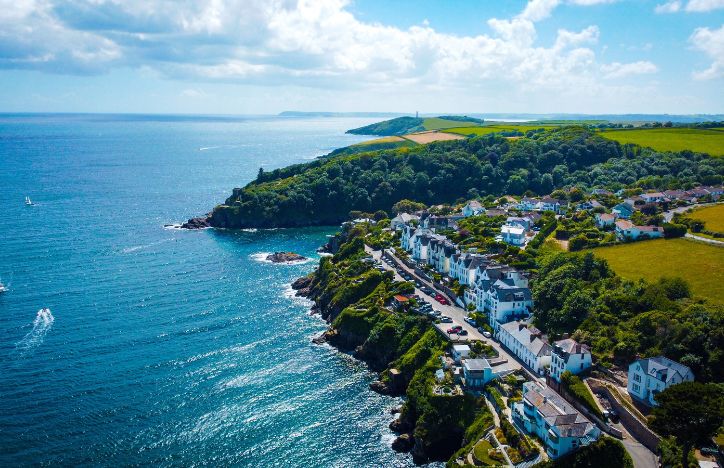
Coastal towns and cities need new homes, investment, and economic renewal, just like many other areas in the UK. A ‘place by the sea’ can also be an attractive prospect with unique locations, views, and access to the natural environment. Delivering viable development here, however, often requires a different approach to more typical inland schemes.
For local authorities and development agencies, the focus is on attracting investment that improves housing supply, strengthens local economies, and supports long term place making. For developers and housebuilders, the question is not whether coastal development is possible, but how schemes can be structured so they compete with potentially lower risk inland alternatives.
This article explores what makes coastal development distinct, how those differences affect housing delivery and regeneration, and what successful coastal projects are doing to unlock long term value.
Coastal locations bring clear advantages, but they also sit within a particular economic, environmental, and physical context. Understanding that context is key to making development work.
Many coastal towns experience long standing economic imbalance. Seasonal employment, lower average wages, and skills gaps can suppress local demand and influence financial appraisals.
Housing pressure is often sharper too. National supply shortages are intensified by second homes, holiday lets and short-term accommodation. This reduces availability for local residents and creates a familiar housing delivery challenge: high levels of need, with viability that often requires a more flexible and joined up approach.
Environmental risk is one of the defining differences between coastal and inland development.
Coastal erosion, flood risk, and climate exposure all increase uncertainty. Sites that might otherwise be viable can become more marginal once mitigation measures, resilience requirements and insurance considerations are factored in.
Many coastal schemes also sit on brownfield land, often former industrial or port related sites. These sites can be complex from the outset, with contamination, access constraints, or ageing infrastructure. Their coastal location often adds a further layer of cost and technical complexity.
Transport and connectivity remain a practical barrier. Poor rail links, limited road capacity, or seasonal congestion can all affect how places function day to day.
For housing schemes, this influences sales values, rental demand, and access to employment. For mixed-use regeneration, it affects footfall, commercial demand, and long-term sustainability.
Individually, none of these factors prevent development. Taken together, they mean coastal schemes need to be approached differently from comparable inland sites.
While these factors shape decision making, they do not stop successful development. Across the UK, well designed coastal projects are delivering homes, investment, and renewal by responding to context rather than resisting it.
Coastal regeneration is less likely to succeed through single-site, single-party development. The scale and nature of the issues involved usually require multiple interests to move together.
Local authorities, ports, landowners, statutory bodies, infrastructure providers, and communities often all have a stake. Collaboration can unlock solutions that would be out of reach for any one party, but it can also add complexity to governance and decision making.
Clear leadership, strong partnerships, and realistic phasing become critical. Where these are in place, complex schemes are far more likely to progress and attract sustained investment.
Despite the added considerations, coastal development can and does succeed. Successful schemes tend to share a few defining features.
Coastal places often have a strong sense of identity and local attachment. Development that works with this, rather than around it, is far more likely to succeed.
Early engagement helps de risk schemes, shape uses and builds confidence. This is particularly important where change affects historic buildings, waterfronts or public spaces that matter to residents.
When communities understand the long-term vision and can see tangible benefits, projects tend to move more quickly and attract broader support.
Single-use housing schemes can struggle in more fragile coastal economies. Mixed-use development is often more resilient.
Combining homes with workspace, food and drink, culture and leisure creates activity beyond peak tourism seasons. It supports job creation and broadens who the place works for.
Historic buildings, particularly around ports and harbours, can act as powerful anchors. Their reuse strengthens identity and can attract investment that may not otherwise follow.
Hybrid working is also leading to a broadening of the seasonal nature of coastal economies, with some areas developing quality workspaces and improved connectivity to attract people who no longer need to commute daily. In places like St Ives, a redundant listed building overlooking the harbour has been successfully repurposed into productive workspace, bringing life back into an underused asset.
Addressing climate risk at the outset can unlock development that would otherwise remain stalled.
The Porthcawl Sandy Bay scheme illustrates this at scale. Long term coastal erosion had increased flood risk, threatened existing homes, and constrained future development.
Investment by the Welsh Government and Bridgend County Borough Council reduced flood risk to around 700 properties and released land for new development.
The key lesson is not just engineering, but confidence. By tackling climate risk strategically, long term development became viable again.
For housebuilders and developers, coastal schemes need a different lens.
Returns may be slower. Phasing matters more. Planning risk and technical evidence requirements are often heavier. But well-designed coastal projects can deliver long term value, stronger place identity, and more resilient demand.
Early engagement, adaptable schemes, and realistic viability assumptions consistently outperform rigid models imported from inland markets.
Coastal regeneration demands patience, partnership, and creativity to deliver places with a strong identity and lasting appeal.
For local authorities and development agencies, the opportunity is not just new homes, but sustainable communities that support local economies year-round. For developers, it lies in creating schemes that stand out in a crowded market and retain their attractiveness over time.
Coastal development is complex. But where public bodies, developers and communities move together with a shared purpose, perceived risk can translate into long term opportunity, with even the most left-behind towns unlocking new futures.
For more information, please contact our regeneration team.

Robin de Wreede
Partner | Head of Real Estate | Joint Head of Public Sector & Government
+44 (0)1392 333820 r.dewreede@ashfords.co.uk View more
Lara Moore
Partner and Head of the Marine sector
+44 (0)117 321 8097 +44 (0)7736 295582 l.moore@ashfords.co.uk View more
David Richardson
Partner | Head of Planning & Infrastructure Consenting | Joint Head of Public Sector & Government
+44 (0)1392 333745 d.richardson@ashfords.co.uk View more
Kate Topp
Partner and Head of the Housebuiling & Development sector
+44 (0)117 321 8026 k.topp@ashfords.co.uk View more