A key issue to establish during due diligence in mergers and acquisitions (M&A) transactions is where potential employment-related liabilities may sit post-completion?
As part of the initial due diligence exercise, buyers should ask the target company whether it's aware of, or involved in, any ongoing or threatened disputes or legal claims with current or former employees. This helps to determine whether specific indemnities or warranties are required to protect against known risks. However, not all employment liabilities will be obvious, and targeted questioning is often needed to identify areas of latent risk.
In this article, we explore the risks associated with off payroll workers and holiday pay, both common areas of employment-related exposure in M&A transactions. We also explore why businesses holding sponsor licences to employ skilled workers matter, the steps that must be taken within tight statutory timeframes, and how to avoid costly penalties when employing sponsored workers.
Off-payroll workers often present an increased risk of employment and tax-related claims. Where a target company engages contractors or freelancers, it's important for the buyer to understand both the contractual terms and the reality of the working arrangements, and to assess whether the engagement is genuinely one of self-employment.

These factors are central indicators used by the courts when assessing employment status, alongside a broader assessment of the overall relationship. Where there is more than minimal control, an ongoing obligation to provide and accept work, and a requirement for personal service, there is an increased risk that an individual may in fact be a worker or an employee.
If reclassified, this could expose the business to claims for additional employment rights, including holiday pay, sick pay, National Minimum Wage, pension auto-enrolment and, potentially, unfair dismissal. Such claims can result in unforeseen liabilities for the buyer post-completion.
There may also be tax implications under the off payroll working rules, IR35 - where a contractor is genuinely self-employed, they are responsible for accounting for their own tax. However, for medium and large companies, the responsibility for assessing employment status for tax purposes and issuing a status determination statement rests with the engaging organisation.
Small private companies are exempt from this obligation. The exemption applies where the company meets at least two of the following criteria:
Turnover of not more than £10.2 million
A balance sheet total of not more than £5.1m
No more than 50 employees
Status determinations can be carried out using HMRC’s CEST tool. During due diligence, buyers should ask whether status determination statement assessments have been completed and request copies of the results, unless the target can demonstrate that it qualifies for the small company exemption.
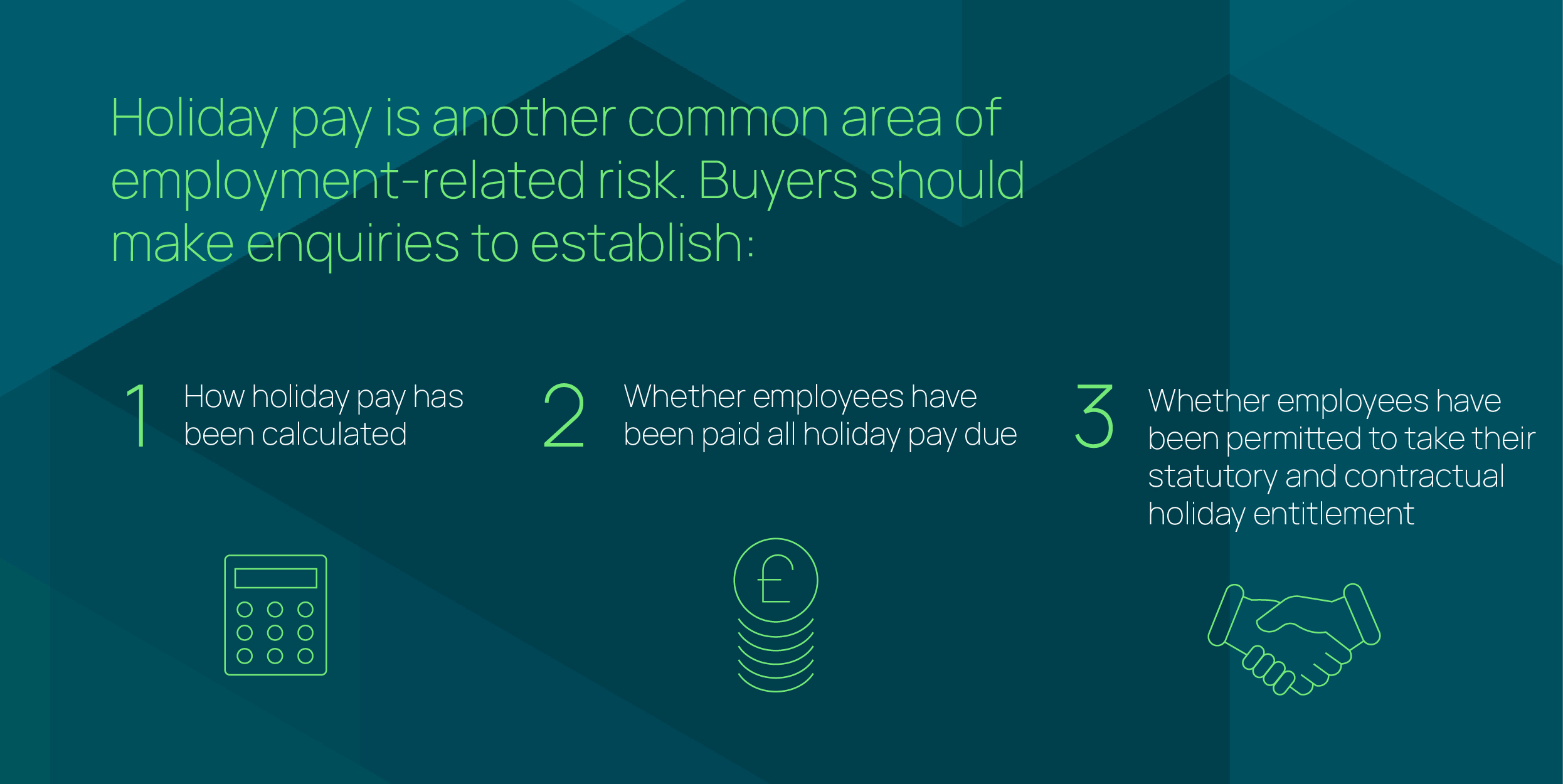
Holiday pay calculations are not uniform and may vary depending on working patterns, pay structure and whether employees are salaried, hourly paid, seasonal or term time only.
The frequent pitfall is the failure to include elements such as regular overtime, bonuses or commission in the calculation of 'normal remuneration'. Where holiday pay has been underpaid, this can result in claims for unlawful deductions from wages, often with retrospective financial exposure.
Where there is any uncertainty, buyers should consider seeking an indemnity to cover potential liabilities arising from incorrectly calculated or underpaid holiday pay, including associated legal costs.
Sponsor licences are not transferable between legal entities following a merger or acquisition. In many cases, there is a 20 working day window post-completion for the employer to take appropriate action, which may include applying for a new sponsor licence in place.
It's therefore critical to assess, during the transaction, whether:
a new sponsor licence will be required,
the existing licence can continue subject to reporting obligations and
the key personnel linked to the sponsor licence will remain in post following completion.
Reporting obligations are almost always triggered where there is a direct change of control in the ownership of the licence holder. Consideration should also be given to whether the buyer already holds a sponsor licence and, if so, whether it needs to report the acquisition or apply to increase the amount its allocation of certificates of sponsorship to accommodate inherited sponsored workers.
Errors in this area can be costly. Civil penalties for employing illegal workers can be as high as £60,000 per worker and serious breaches can also carry criminal and reputational consequences. Sponsor licence compliance should therefore be addressed at an early stage of the transaction.
Ashfords' employment team regularly advises employers during and after M&A transactions, on the people-related risks outlined assisting in this article. If your business is involved in an M&A transaction and would like advice, please contact our employment team to discuss how we can assist.