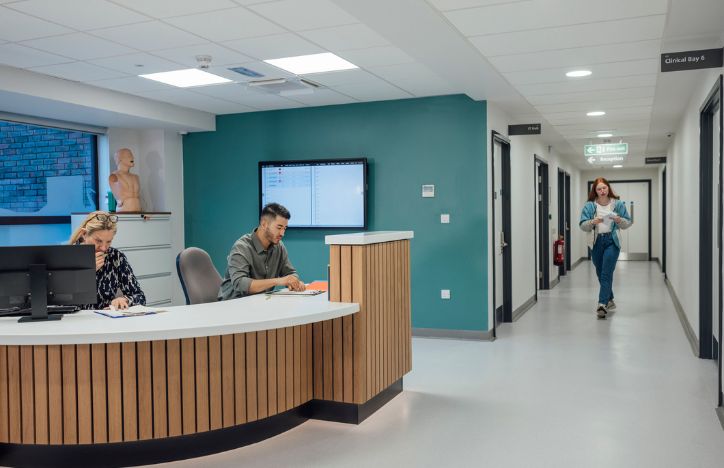
Building management is a key part of running a GP practice. Many GP practices will have a bank loan secured against the premises and lenders have specific legal requirements relating to the building which GPs will need to ensure they are compliant with. These requirements need to be met when GPs refinance, secure additional lending or when old partners leave and new partners join the partnership.
This article, part of our 'A legal toolkit for GPs' series, focuses on some of the key premises management issues that GPs should be aware of.
It's important that the title register of the premises and the legal mortgage are updated when old partners retire and/or new partners join the partnership.
A property transfer is required to update the legal ownership of the premises at the Land Registry. The Land Registry allows up to a maximum four individuals to be registered as legal owners on the title register at Land Registry. Those chosen partners will hold the legal interest in the premises on trust for all of the partners in varying proportions set out in a partnership agreement.
In some cases, a declaration of trust and/or transfer of beneficial interest can be used to formally document the transfer of a retiring partners interest in the premises to the continuing partners, and declare the resulting ownership split of the premises between the continuing partners.
It's important that these documents are entered into on each occasion a partner joins or leaves the partnership.
GPs will operate under a partnership agreement which will include provisions relating to the surgery premises.
If the premises is freehold, it's important to clarify the ownership split of the capital of the premises between the partners, and how any other building costs or responsibilities will be split, if not assumed by the partnership as a whole - for example repairs and maintenance costs, and mortgage repayments.
If the premises is leasehold, it will be important to establish which partners are responsible for compliance with the lease covenants and responsibilities under the lease such as dilapidations.
It's important that GPs keep their buildings insurance up to date and that the policy terms, and level of cover, satisfy the requirements of the GP’s lender. Failure to do so can invalidate the insurance policy and could put GPs in breach of the conditions of their mortgage.
The buildings insurance policy should contain the following:
If GPs own their premises under a long or short term lease, landlord consent may be required to the grant of a mortgage, underletting, sale and/or any alterations carried out to the premises. It's important to check the lease terms carefully as a failure to obtain landlord consent can give the landlord a right to forfeit the lease and, in the case of a failure to obtain landlord consent to the grant of a mortgage, can invalidate the mortgage.
It's also important to ensure that the lease meets the bank’s requirements and does not include any unusual or overly burdensome terms, such as a lack of a mortgagee protection clause or a right to forfeit the lease on tenant insolvency.
It's important to use an NHS approved GP surgery lease if GPs are putting a new lease in place. The NHS and Integrated Care Board play a key role in the rent review and lease renewal process, therefore it's important to obtain a sector specific NHS GP surgery lease which is approved by the NHS.
The Integrated Care Board will ensure the lease contains necessary protections, for example that the rent cannot exceed the amount the GPs are reimbursed from the NHS. If not, negotiations with the landlord on rent review may become difficult as the lease may contain provisions which the NHS has not approved.
A Display Energy Certificate (DEC) is required for buildings with a total useful floor area over 250m2, that are occupied by public authorities or institutions providing public services, and frequently visited by the public. The rules require occupiers of buildings which meet the criteria, including GP premises, to comply with the following obligations:
The DEC must be displayed in a prominent place where it's clearly visible to members of the public visiting the premises. DECs last for one year for buildings with a total useful floor area more than 1,000 square metres. They last for 10 years when the total useful floor area is between 250 square metres 1,000 square metres.
A local authority can issue a penalty charge notice of £500 for failing to display a DEC, and £1,000 for failing to possess or have in their control a valid advisory report.
GPs need to make sure that there is a DEC on display in the GP surgery and that it's renewed when required, to avoid facing potential penalty fines.
Owners or occupiers of commercial premises must carry out an asbestos survey and, if asbestos is identified in the building, a management plan put in place.
GPs will be required to demonstrate compliance with asbestos regulations and provide a copy of any management plan in place on a sale, loan, refinance or lease.
The use of asbestos containing materials was outlawed in 2000, therefore if the surgery building was constructed after this date it's unlikely the premises will contain asbestos. However, it's notable that a large number of GP premises are old buildings, therefore it's important that a survey and management plan is carried out and obtained for those buildings.
If you have any enquiries regarding premises management of your GP surgery premises, please contact Jessica Hedges and Ben Tarrant.
This article is a part of our 'A legal toolkit for GPs' series - a collection of articles designed to help GPs understand and navigate common legal issues they face in day to day practice. Find the full series below.
We produce a range of insights and publications to help keep our clients up-to-date with legal and sector developments.
Sign up