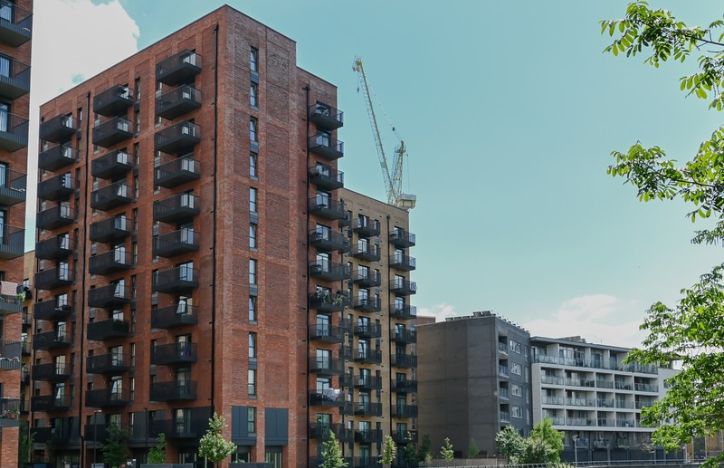
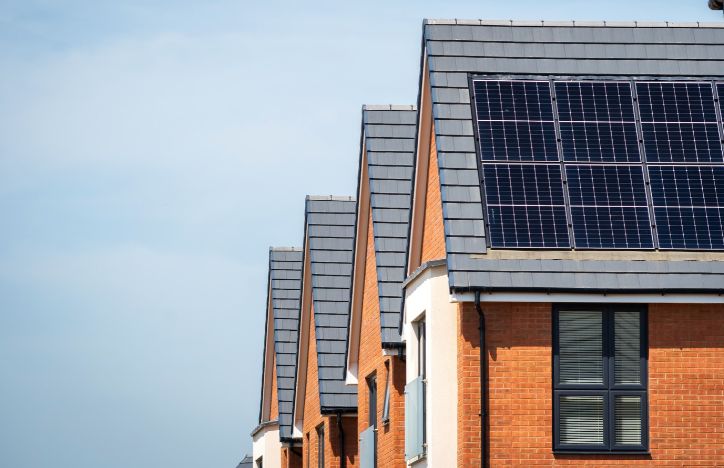
Plug-in solar is set to become a more familiar feature of homes and residential developments.
But whilst this will make small-scale renewable energy increasingly accessible to homeowners and tenants, for residential developers, particularly those delivering flats and managed estates, they also raise practical questions about what residents can attach to balconies, external walls and other parts of a building. This article considers what residential developers need to know about plug-in portable solar panels.
Since 27 August 2026, households in England, Scotland and Wales have been able to buy and use portable photovoltaic kits that plug into a standard socket.
The equipment can be positioned on a balcony, garden fence, patio or shed roof and, unlike conventional rooftop systems they don’t need to be installed by an electrician. It is also portable, so residents can take it with them when they move. Consumers should nevertheless check their existing electrical system is suitable before installation and notify their local DNO (Distribution Network Operator), normally within 28 days of installation to allow for proper management of the local electricity network.
With the direction of travel, it won’t be long before plug-in solar panels are available down the middle aisle of certain popular supermarkets, between the power tools and yoga mats.
For residential developers, however, greater accessibility raises a different question: what happens when individual residents want to install their own equipment after a plot has been sold?
This is particularly relevant to apartment and managed developments, where the proposed location for a panel or its associated equipment may involve the external appearance or structure of the building, retained parts or common areas.
As the regulatory environment around small-scale energy generation evolves, developers should consider whether their plot documentation gives them sufficient control over where this equipment can be installed and how it may affect the appearance, safety and management of a development.
On an apartment development, a resident might want to attach solar panels to a balcony balustrade or railing or position them on a terrace. Elsewhere, owners might seek to fix panels or associated equipment to an external wall, outside the front of their property, or in areas outside their ownership or in shared communal outside space.
That can create a number of issues for developers, landlords and management companies:
Appearance of the development - a range of different panels installed by individual owners could affect the external appearance and uniformity of an apartment building or wider estate. One resident’s renewable energy solution may, after all, be another resident’s objection to what has suddenly appeared on the balcony adjacent to them.
Building fabric and safety - where equipment is fixed to a building, fixings and penetrations could affect façades, waterproofing, cladding and other external elements. Installations at height may create additional safety considerations, while panels, cabling, inverters and other apparatus could also raise electrical and fire safety issues.
Ownership issues - a leaseholder may, for example, have use of a balcony without owning its structural elements, balustrade or the external wall. An apparently straightforward installation could therefore involve parts of the building retained by the landlord or owned and managed by a management company.
Wider implications - developers should also consider the potential implications for building warranties, insurance and future maintenance, as well as whether individual installations could conflict with a development-wide approach to such installations.
The starting point for developers should be their standard leases, transfers and estate regulations.
Existing restrictions on alterations and changes to external appearance may already provide some protection. However, it is worth considering whether those provisions are sufficiently clear and flexible to deal with technology that may not have been contemplated when the documents were drafted.
In particular, developers should consider:
External alterations: do the documents adequately control the fixing of panels and other equipment to external elevations of buildings and outside areas?
Balconies and terraces: is it clear what forms part of the property or demise and what residents may attach to balustrades, walls and other structures?
Solar and associated equipment: should restrictions expressly cover solar panels, plug-in solar panel equipment, inverters, cabling and related apparatus?
Common and retained parts: are works affecting communal areas, retained structures or shared infrastructure adequately controlled?
Estate regulations: is there sufficient flexibility to introduce or update reasonable requirements as technology and industry practice develops?
A blanket prohibition is unlikely to be particularly consumer friendly. A consent regime may give developers, landlords and management companies greater flexibility, allowing suitable installations while retaining control over their location and specification.
Where consent is given, it could be subject to conditions dealing with matters such as structural and electrical safety testing, compliance with applicable standards, registration and consents requirements, insurance, ongoing maintenance and responsibility for making good any damage.
Developers should also consider whether the documents should require equipment to be removed and the property reinstated if it becomes unsafe, obsolete or is no longer in use.
Plug-in solar panels are a good example of residential technology developing faster than many standard plot documents.
For new schemes, and when standard documents are next reviewed, developers should check that leases, transfers and estate regulations can deal effectively with resident-installed solar equipment. The answer does not necessarily have to be a blanket prohibition. The key is ensuring the documents put the relevant landlord, management company or estate manager in control of where and how equipment can be installed, with appropriate safeguards around appearance, building fabric, safety, maintenance and reinstatement.
Building those controls into the documentation from the outset should put developers in a much stronger position than trying to deal with an unexpected installation after plots have been sold.
If you would like to discuss how plug-in solar could affect your development or plot documentation, please contact our housebuilding and development team.
We produce a range of insights and publications to help keep our clients up-to-date with legal and sector developments.
Sign up