Disputes frequently arise in family-run farming partnerships as to whether significant assets, such as the farm buildings and land, are owned by the partnership or remain the property of the individual who originally introduced the asset into the business.
These disputes often arise following the death of a partner. It's often the case that formal documentation is limited and arrangements have evolved over time - sometimes across several generations and with assets passing by inheritance - but without any clear articulation of the parties’ agreed intentions. Such disputes can become complex and emotionally charged, particularly where promises of inheriting the farm have been made.
This article explores how courts determine whether farmland and other key assets belong to a farming partnership or remain the personal property of individual partners, and the steps farmers can take to avoid costly ownership disputes.
Many family-run partnerships operate without a written partnership agreement. In those circumstances, or where there is a poorly drafted or incomplete partnership agreement, the default provisions of the Partnership Act 1890 apply - often with unintended consequences.

The effect of these provisions can be significant. If land owned by one partner is found to have become partnership property under section 20, it forms part of the 'capital of the business'. In the absence of clear evidence of a contrary intention, section 21 will operate so that all partners may acquire an equal share in that asset.
Partnership accounts are often relied upon as a key indicator of ownership.
In practice however, it's not uncommon for accountants and partners alike to fail to appreciate that including land as a partnership asset in the accounts may suggest a change in its underlying ownership. The accounts may therefore give a misleading impression of the parties’ true intentions.
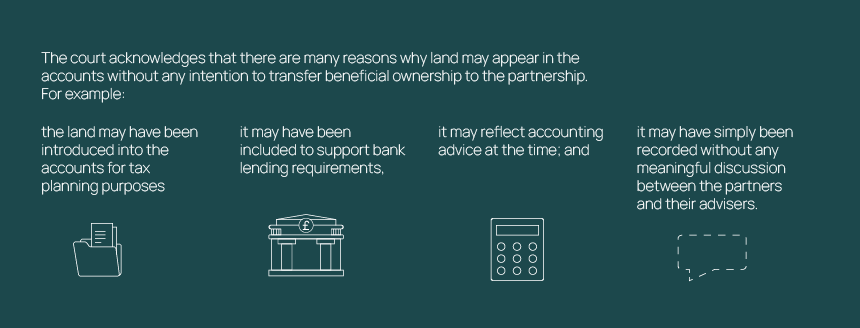
Therefore, although the inclusion of land in the accounts gives rise to a presumption of partnership ownership, it's only the starting point and that presumption can be displaced by sufficient evidence to the contrary.
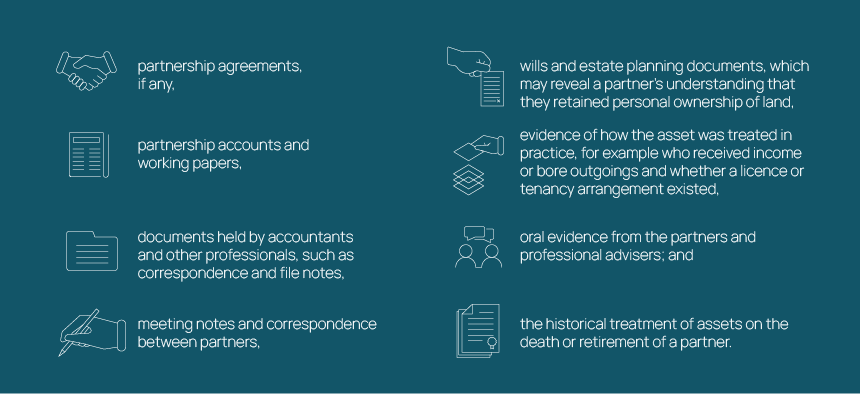
When determining whether an asset forms part of the partnership, the court undertakes a fact-sensitive analysis of the complete factual matrix. The court will consider:
The decision in Wild v Wild provides a useful illustration of the court’s approach to these claims.
In Wild v Wild one brother, Gregory, issued a claim against his mother, brother and sister-in-law for a declaration that certain assets, including land and property, were partnership property, and not assets of his late father’s estate.
There was no written partnership agreement and no express discussions had taken place regarding the ownership of the land. However, the assets had been used in the farming business for many years and were included within the partnership accounts. Relying on the statutory provisions of the Partnership Act 1890, Gregory contended that the assets had become partnership property and that he was therefore entitled to a share of their value following the dissolution of the partnership.
The court rejected that argument. The judge held that the partnership’s use of the land, together with its inclusion in the partnership accounts, was insufficient to demonstrate a clear intention that the assets should become partnership property.
The court emphasised that the mere use of land in a partnership business does not convert it into a partnership asset - an observation of particular relevance in the context of family farming partnerships, where it's common for land owned by individual partners to be used by the partnership without any transfer of ownership.
A significant feature of the case was the evidence given by the partnership accountant under cross-examination. The accountant accepted that the assets had been included in the accounts largely because that was how they had been treated historically, including by previous accountants, rather than as a result of any considered decision about ownership.
Crucially, there was no clear, unambiguous evidence of an intention to transfer beneficial ownership of the assets to the partnership. Accordingly, notwithstanding their treatment in the accounts, the court concluded that the assets remained the personal property of the deceased.
Many of these disputes arise not from deliberate disagreement, but from a lack of communication, informal arrangements, and often a disconnect between the parties actual intentions and accounting treatment.
A number of practical steps can significantly reduce the risk of uncertainty and a potential dispute:

Disputes over farm partnership assets are rarely straightforward. They often arise from a combination of informal arrangements, evolving business practices, and insufficient clarity as to ownership.
Where a dispute has arisen, the court will look beyond the partnership accounts to determine the true position. Ultimately, intention - assessed against the full factual matrix - remains key. Prevention, however, is always preferable to cure. Careful documentation, regular review of partnership arrangements, and a clear understanding of the legal consequences of accounting treatment are essential to minimise the risk of such disputes arising.
Close collaboration between legal advisers and accountants is particularly important to ensure that the parties’ intentions are consistently and accurately reflected in both the partnership agreement and the accounts.
Our specialist team has extensive experience advising on farming partnerships, and we regularly work alongside accountants and other professional advisers to provide coordinated, practical advice and solutions. Contact our disputed wills team for a no obligation chat to see how we can help.
We produce a range of insights and publications to help keep our clients up-to-date with legal and sector developments.
Sign up