We often get asked ‘how can I remove a trustee?’ and in this guide we explain how trustees can retire, be removed or replaced. We also consider practical issues such as what can be done when a trustee dies or loses capacity.
Trustees hold the trust assets for the benefit of the beneficiaries of the trust. The position of a trustee is one of significant legal responsibility as trustees have a number of legal obligations and duties. The ability to remove trustees from their office are an essential part of the protection of the interests of the beneficiaries and the quality of trust administration.
While it’s possible for the trustees of a trust to remain in position for the duration of the trust, trusts can last for many years and it’s very common for the trustees to need to change over time.
There are a number of different powers available to change a trustee:
When considering a change of trustee, the starting point must always be to review the trust document itself as it may give power to appoint, substitute and remove trustees. If such a power exists then matters are greatly simplified and provided that the change can be effected in the manner prescribed in the trust document, there is unlikely to be any scope for a challenge.
If however the deed is silent, or the person with the power to change or appoint trustees is unable or unwilling to do so, then it may be necessary to rely upon one of the other statutory routes set out below. When considering your options however it’s still very important that you have carefully considered the trust document in full as it may restrict the statutory powers that would be otherwise available.
Our flowchart below outlines potential circumstances in which you may need to change a trustee, and explains the most appropriate course of action to take in each scenario.
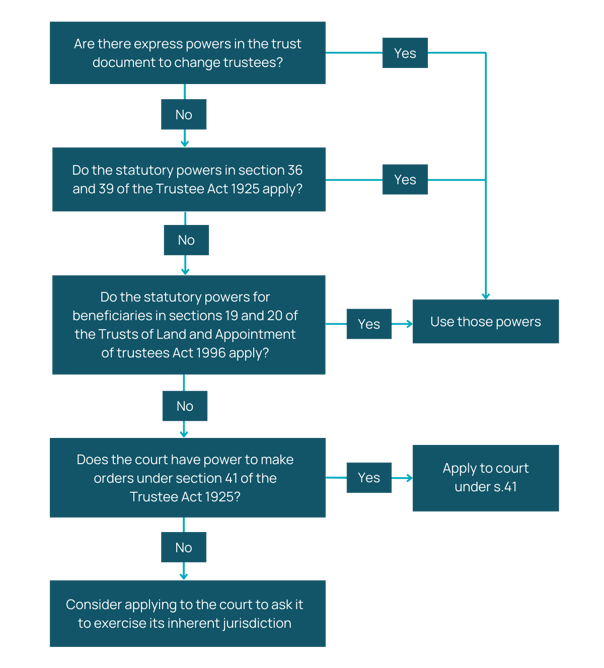
Section 36 can be used to remove a trustee and appoint another in their place where the trustee:
However, there are limits on who can remove a trustee under section 36. The person nominated by the trust document can rely upon section 36, or if the trust document is silent and the person nominated to have the power is unable or unwilling to act, the other trustees can do so. If there are no trustees alive then the personal representative(s) of the last surviving trustee can appoint a new trustee.
Section 36 is therefore not automatically available to beneficiaries of a trust, at least not in that capacity.
We often get asked whether an attorney appointed under a lasting power of attorney of an incapacitated trustee can act in place of the trustee. The simple answer is no. An attorney will not automatically step into the shoes of a trustee who has made an lasting power of attorney. Steps will need to be taken to remove the incapacitated trustee.
It is also important to flag that if a mentally incapable trustee is also a beneficiary, permission must be sought from the Court of Protection before the change of trustee is made. This is only necessary if the beneficiary has an interest in possession, and it does not apply if the beneficiary merely has a potential interest under a discretionary trust.
If the incapacitated trustee has no beneficial interest and is the only trustee then the personal representatives of the last of the other trustees to die can appoint a replacement.
It's not advisable to use section 36 where there is likely to be a dispute over whether, for example a trustee is ‘unfit’ or ‘incapable’, instead it would be necessary to make an application to the court. Section 36 is therefore only really appropriate where the criteria are met and there is no likely challenge to the removal of the trustee.
Section 39 is applicable where one of the trustees, who is mentally able, wishes to retire without appointing a replacement. A mentally incapacitated trustee cannot, by himself/herself alone, retire.
Put simply, section 39 states if after retirement there will remain in place a trust company or at least two other trustees, then the person who wishes to retire can do so by deed, providing the others also consent by deed.
The end result will be that the outgoing trustee will be discharged without any new trustee being appointed. If a trustee wishes to retire and that would leave only one trustee then the retiring trustee needs to be replaced.
Section 19 of TOLATA provides that where the trust document doesn’t give anyone the power to appoint new trustees, the beneficiaries, if all are in unanimous agreement, may be able to remove and appoint a trustee under section 19 of TOLATA.
However, in order to rely on section 19, all of the beneficiaries must be of full age and capacity, and together be absolutely entitled to the trust property. If there are discretionary trusts, the class of beneficiaries must be closed and all members of the class must consent.
If the above conditions are satisfied, the beneficiaries can give written direction to a trustee or trustees to retire from the trust and/or to the appointment of a new trustee. A trustee who receives a written direction to retire must then make a deed declaring his retirement. If the trustees refuse to cooperate, the beneficiaries may apply to the court.
Similarly, section 20 of TOLATA provides that where the trustee has lost capacity, if there is no person who is willing and able to appoint a trustee in place of the incapacitated trustee under section 36 of the Trustee Act, the beneficiaries, with the same principles above applying, can give written direction that the incapacitated trustee is replaced by a specified person. Unlike section 19, section 20 applies even where a person is nominated for the purpose of appointing new trustees.
The beneficiaries may give the relevant direction to the trustee’s attorney, appointed by a lasting power of attorney, or court appointed deputy or any other person authorised for the purpose by the Court of Protection.
Before beneficiaries attempt to rely upon either section 19 or 20 of TOLATA however, it’s important that they check that the trust document does not exclude its operation.
Where there is no other mechanism available, an application to the court might prove necessary. You may be surprised to learn that a significant proportion of court time is spent dealing with applications to remove trustees.
There are essentially two possible routes to remove a trustee by the court:
Typically a claim under Section 41 is likely to be most appropriate where you are seeking to appoint a new trustee, in place of the existing trustee and there are no substantial disputes of fact. As a point of good practice however, it is always sensible to also apply under the court’s inherent jurisdiction in the alternative.
In any application to court for the removal of a trustee, it’s often important to have sought the views of as many of the beneficiaries as possible and the results of any consultation should be put in evidence before the court
Section 41 is the most common method used to remove trustees by order of the court. However, it should be noted that this is an application that should only be made where there are no other means by which a trustee can be substituted. The court may also only remove a trustee under section 41 if a new one is to be substituted in their place.
Section 41 provides that the court may, whenever it is expedient to appoint a new trustee or trustees, and it is found inexpedient, difficult or impracticable to do so without the assistance of the court, make an order appointment a new trustee or trustees either in substitution for or in addition to any existing trustee or trustees.
It’s expressly provided that section 41 is intended to apply where the trustee lacks capacity, is bankrupt or is a corporation which is in liquidation or has been dissolved. The court is also able to appoint a new trustee where there is no existing trustee.
Any beneficiary or trustee can apply for an order under this section using the court’s part 8 procedure of the Civil Procedure Rules.
With regards to the court’s inherent jurisdiction, the main principle on which such jurisdiction will be exercised is the welfare of the beneficiaries and of the trust. The court will have regard to protecting the trust property and ensuring the efficient and proper execution of the trusts. The exercise of the court’s inherent jurisdiction involves a delicate balance and much will depend on the facts of the individual case.
There are a number of reasons why a trustee may be removed, for example misconduct or breach of trust, but even where there is proof of wrongdoing, this does not automatically justify removal. It may be that there has been a breakdown in relations between the trustee and beneficiaries, but friction or hostility between trustees and beneficiaries, or feelings of mistrust on the part of the beneficiaries, are not, by themselves, enough to justify the removal of trustees.
The question is whether the efficient administration of the estate remains possible. If therefore the breakdown in relations is likely to jeopardise the proper administration of the trust or estate, this may persuade the court to remove the trustees.
With regard to costs, a defended claim to remove a trustee is hostile litigation, so costs will normally follow the event. Costs are always at the discretion of the court, but the standard position is that, where a trustee is removed by the court on their having refused to relinquish their role, the court will order the trustee to pay the costs of their own removal.
For more information, please contact the trusts and estates team.
We produce a range of insights and publications to help keep our clients up-to-date with legal and sector developments.
Sign up